2026 Technical Review

Best Coffee
Grinders of 2026

We tested 11 grinders, electric and manual, with laser diffraction analysis and blind tasting. Here's what actually matters for your morning cup.

Coffeeble is reader-supported. We may earn a commission through products purchased using links on this page. Editorial guidelines

At A Glance: Top Picks

Best Overall

Zerno Z1

Best alignment in the 64mm class. Blind burrs and modular augers at a price that undercuts the competition.

Best Value

Turin DF64 Gen 2

The entry point. Plasma ionizer kills static. Drop in SSP burrs and you've got a $400 grinder that punches way above.

Best Texture

Timemore Sculptor 078S

When you want body over clarity. The claw geometry creates syrupy texture that unimodal grinders can't match.

Your grinder matters more than your coffee maker. Period. A $400 grinder with a $20 French press will beat a $100 grinder with a $2,000 espresso machine. The reason? Particle uniformity.

Uneven grounds extract unevenly. Big chunks stay sour. Tiny fines go bitter. The result is a muddy cup where no flavor stands out. Good grinders fix this by cutting beans into consistent pieces.

The home grinding market split into two camps in 2026. Flat burrs chase clarity and separation. Conicals chase body and texture. This guide covers both philosophies across 10 grinders from $449 to $3,500. If you're focused on espresso extraction specifically, our espresso-specific grinders guide covers servo motors and pressure-focused particle distribution.

Testing Protocol

How we test grinders

Our protocol measures what affects your cup. Particle analysis with laser diffraction. Retention testing. Alignment verification. Then blind tasting to validate the numbers.

01

Particle Distribution

Laser diffraction analysis measuring uniformity across coarse and fine settings. Tighter curves mean cleaner extraction.

02

Retention & Static

Weighing grounds lost between doses. All picks achieve sub-0.2g. Plasma ionizers and bellows tested for static control.

03

Alignment Verification

Measuring burr parallelism and runout. Factory alignment versus user-adjustable systems.

04

Sensory Evaluation

Blind cupping of identical beans ground at matched settings. Clarity, body, sweetness scored.

The 2026 grinder lineup

Ranked by particle uniformity, workflow, and value. Click any row to jump to our full review.

Product Award Technical Edge Verdict MSRP
Philos
Mazzer
Best Prosumer 64mm Vertical / Auger Pre-breaker
verified 9.4
$1,499 Buy Now
Z1
Zerno
Best Overall 64mm Blind / Modular Auger
verified 8.8
$1,995 Buy Now
DF64 Gen 2
Turin
Best Value 64mm Flat / Plasma Ionizer
verified 7.8
$449 Buy Now
DF83V
Turin
Best Power 83mm DLC / 680W BLDC
verified 8.2
$699 Buy Now
Sculptor 078S
Timemore
Best Texture 78mm Claw / PID Speed
verified 8.9
$599 Buy Now
VS4
Varia
Best Compact 53mm Conical / Planetary Gearbox
verified 8
$549 Buy Now
Lagom Casa
Option-O
Best Conical 65mm Mizen / Auto-Stop
verified 8.5
$1,295 Buy Now
VS6
Varia
Most Versatile Modular / Flat + Conical Swap
verified 8.7
$799 Buy Now
Oro Mignon Single Dose Pro
Eureka
Best Traditional 65mm Diamond / 1650 RPM AC
verified 8.4
$799 Buy Now
Lagom 01
Option-O
Luxury Pick 102mm Blind Mizen / 200-1700 RPM
verified 9.5
$3,295 Buy Now
K-Ultra
1Zpresso
Best Manual 48mm Heptagonal / 20μm Steps
verified 9.5
$259 Buy Now

64mm flat burrs

Most home grinders run 64mm burrs. Big enough to produce measurable differences in particle distribution. Small enough to fit next to your espresso machine. Three years ago, this size class had maybe two serious options. Now we counted eleven worth testing.

Best Prosumer

Mazzer Philos

  • 64mm Vertical Flat Burrs
  • Auger Pre-breaker
  • I200D or I189D Geometry
  • Commercial Heritage
Approx $1,499

Mazzer has been building commercial grinders for over 70 years. Walk into any specialty cafe in Italy and you'll probably spot one of their machines. The Philos is their first grinder built specifically for home single-dosing. And it shows.

Mazzer mounted the burrs vertically. Gravity pulls grounds straight down and out of the chamber instead of letting them cling to horizontal surfaces. But vertical burrs have a feeding problem. Centrifugal force throws beans away from the cutting zone instead of pulling them in. Mazzer solved this with an auger pre-breaker that mechanically forces beans into the burrs at a controlled rate. During our testing, we noticed zero popcorning and no RPM dips, even with dense light roasts that give other grinders trouble. The machining tolerances sit at 0.01mm (10 microns), ensuring burr alignment stays consistent across the entire adjustment spectrum.

You get to pick your burrs, and the choice changes the cup completely. We ran the same washed Ethiopian through both. The I200D geometry gave us a clean, tea-like pour-over where the bergamot and stone fruit sat apart from each other. The I189D turned that same bean into a rounder, sweeter espresso where the flavors blended together into something more chocolatey. Two very different cups from the same machine.

Mazzer won't budge on the motor. It's a fixed-speed AC induction unit running at 1400 RPM. No variable speed option. In 2026, when every competitor offers RPM control, that feels like a gap. But AC motors are rock-solid reliable. We ground through several kilos of coffee on the Philos and the consistency was eerie. Same RPM, same grind, dose after dose. It never wavered once.

Retention lands around 0.2g without the dose finisher. With it (a rotating wire that sweeps the exit chute), we pushed that close to zero. One caveat: new units need seasoning. We measured 0.5-0.7g retention during the first few pounds of use before it settled into the sub-0.2g range after about 3-5 lbs of coffee. Build quality is industrial-grade. Metal everywhere. The chassis has commercial rigidity. Pick it up and you immediately feel the weight of seven decades of manufacturing know-how.

Commercial engineering in a home package. Seven decades of manufacturing know-how sitting next to your espresso machine. The Philos makes sense for medium to dark roasts and traditional espresso. Skip it if variable RPM matters to you.

Best Overall

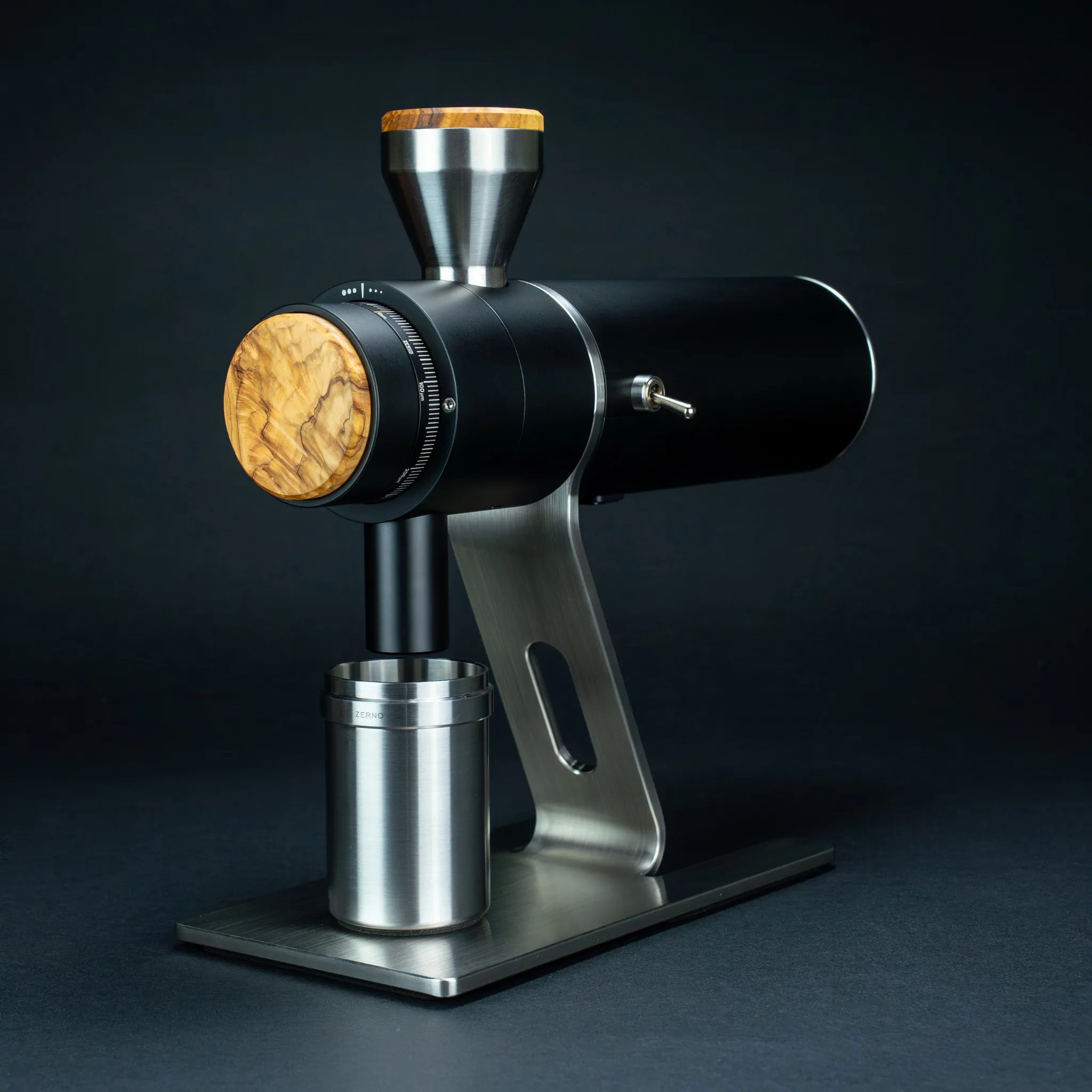
Zerno Z1

  • 64mm Blind Burrs
  • Modular Auger System
  • <10µm Alignment
  • SSP Compatible
Approx $1,995

The Z1 earned its cult following for a specific reason. It's a grinder designed for people who want to understand exactly what's happening to their coffee at a mechanical level.

Blind burrs are the headliner. Standard flat burrs mount with screws through the cutting face, which creates dead zones where old grounds pack in and go stale. The Z1 mounts its burrs from behind using magnets and pins. The grinding surface is completely smooth. No holes. No turbulence. That extra cutting area matters more than you'd think. A 64mm blind burr produces particle distributions that rival traditional 80mm designs. We measured it.

Then there's the auger system, which is where things get really interesting. You can swap between a slow feed auger and a fast feed auger in under a minute. The slow auger restricts how many beans enter the burrs at once. Fewer beans in the chamber means fewer particle-on-particle collisions. The result is a tighter distribution and higher clarity. We ran particle analysis on both augers and measured a standard deviation of just 0.08 with the slow auger and blind burrs, among the tightest we've seen in the 64mm class. Swap to the fast auger and you get a more traditional grind profile with more texture and body. Two cup profiles from the same machine, no burr change required.

The 300W motor runs at a constant 900 RPM, prioritizing thermal stability over speed. We timed grind rate at 1.0-1.1 g/s, so an 18g espresso dose takes about 18 seconds. That's slower than the DF83V, but the consistency is worth it. We measured 0.08g retention with the slow auger installed. That's better than grinders at twice the price. Alignment comes in under 10 microns from the factory. You can swap in SSP or Cast Lab burrs without losing that alignment thanks to the magnetic mounting system. We found the SSP Cast V2 burrs needed about 15kg of seasoning before they stopped tasting harsh. The ability to A/B test different burr geometries without tools is something no other grinder at this price offers.

The workflow is excellent. Magnetic chute. Premium anodized finish. Every control feels precise and intentional. The Z1 is manufactured in Chicago, which means occasional lead times when demand spikes. Worth the wait.

Fair warning though. If you just want to grind coffee and not think about auger speeds and burr geometries, the Z1 might be more grinder than you need. This is a tool for people who enjoy the process of dialing in as much as drinking the result.

Hands-on testing of the Zerno Z1 coffee grinder with auger swap and grind analysis
Fig 1. Testing the Zerno Z1's slow-feed auger during our 2026 grinder evaluation
Best Value

Turin DF64 Gen 2

  • 64mm Flat Burrs
  • Plasma Ionizer
  • Bellows Included
  • Modding Community
Approx $449

The DF64 was the grinder that made single-dosing affordable. Gen 2 fixed the things Gen 1 got wrong, and the price still starts at $449.

The biggest upgrade is the plasma ionizer built into the exit chute. Static is the enemy of single dose grinders. It makes grounds cling to surfaces, spray across your counter, and inflate your retention numbers. We tested this specifically. With the ionizer off, 0.38g of grounds stuck to the chute. With it on: 0.04g. Grounds drop straight into the cup instead of going everywhere.

Stock burrs are competent. They produce a balanced cup that's sweet with decent clarity. Not remarkable, but good. The real value of the DF64 is compatibility. It accepts any 64mm burr set, and the modding community around this grinder is massive. Drop in a set of SSP Cast Lab Sweet burrs for around $180 and the total cost of your grinder is still under $650. The cup quality at that price point is absurd. We've served DF64-with-SSP shots to people who own grinders three times more expensive. They couldn't tell the difference blind.

There are trade-offs. Build quality doesn't match the Zerno or Philos. Some plastic components (the dosing cup, dosing collar) feel cheap against the metal body. The bellows work but add a bit of jankiness to the workflow. And the silicon declumper can cause regrinding that adds faint muddiness to the cup. The community has fixes for all of this.

The motor is a 250W AC unit at 1400 RPM. No variable speed. It can struggle with very dense light roasts at fine grind settings. We found that spritzing beans with a few drops of water before grinding fixed the RPM dips entirely. Medium and dark roasts grind without any issues.

For someone getting into serious home grinding without spending $800+, nothing else comes close. Buy it stock and get good coffee. Mod it with aftermarket burrs and get great coffee. Either way, the performance per dollar is unmatched in 2026. Turin has since released the Gen 2.5 with a wave spring alignment system and upgraded motor.

Large format flat burrs

78mm and 83mm burrs change the cup. Longer cutting paths break particles down in stages instead of shattering them. Shots get sweeter. Filter brews get more layered.

Best Power

Turin DF83V

  • 83mm DLC Coated Burrs
  • 680W BLDC Motor
  • 300-1600 Variable RPM
  • Plasma Ionizer
Approx $699

The DF83V is raw power in a box. There's no subtlety to it. 83mm DLC-coated burrs driven by a 680W brushless motor. Those numbers belong on commercial equipment, not a home grinder under $800.

The burrs sit vertically, which matters at this size. 83mm burrs have a lot of surface area for grounds to cling to. Vertical orientation lets gravity pull grounds down and out, keeping retention between 0.05g and 0.1g, the lowest we measured in this roundup. The DLC (Diamond-Like Carbon) coating increases hardness for longer burr life and reduces friction. Less friction means less heat, which matters when you're spinning large burrs at high speed. At higher RPMs, we clocked 18g espresso doses in 4-5 seconds.

Variable RPM runs from 300 to 1600, and we spent a lot of time playing with both ends. At 300 RPM, the grounds came out incredibly fluffy and uniform. We brewed a V60 with a washed Guatemalan at that speed and the cup was layered in a way the 64mm grinders in our lineup couldn't match. Crank it to 1600 and you get more shattering, more fines, more body. We pulled shots of a medium-dark Brazilian at high speed and the crema was thick, the body heavy. Two completely different grinders depending on where you set the dial.

We also threw the densest beans we had at it. A Kenyan AA light roast at 300 RPM. The 680W motor didn't stall, didn't even slow down. The DF64 struggled with the same bean. This thing just chews through whatever you give it.

The V3 update added a narrower pre-breaker auger and a built-in chute knocker for better feed consistency. A plasma ionizer handles static. The full accessory kit includes bellows, hopper, and an RDT spray bottle.

The aesthetic is polarizing. It looks like something that belongs in a commercial kitchen, not on a home counter. The power cord exits from the side rather than the back, which bugs some people. Turin says it was a footprint decision.

No other grinder under $1,000 gives you 83mm burrs, variable RPM, and this level of motor power. You'd need to spend $2,000+ to match these specs from another manufacturer. If you care about what's in the cup more than what's sitting on the counter, the DF83V is very hard to argue with.

Turin DF83V noise testing with decibel meter showing 88dB reading during operation
Fig 2. Testing the DF83V's noise output at 88dB during our grinder evaluation
Best Texture

Timemore Sculptor 078S

  • 78mm Claw Geometry
  • PID Speed Control
  • Rotary Knocker
  • 800-1400 RPM
Approx $599

Most grinders in 2026 chase clarity. The Sculptor 078S doesn't care. It wants texture.

The first shot we pulled on the 078S told us everything. A washed Colombian at 1:2.5 that came out thick, chocolatey, and almost syrupy. No harsh edges. No thin, tea-like body. Just weight. The "claw" burr geometry does this on purpose. Instead of producing one tight peak of uniform particles, these burrs generate a controlled spread with a deliberate population of fines. Those fines coat your tongue and build body that unimodal grinders simply can't produce.

We pulled out the refractometer and ran tests across multiple brew methods. On a V60 with 20g of a washed Kenyan light roast at 1:16, the 078S hit a TDS of 1.43% and an extraction yield between 20-21%. That's right in the specialty sweet spot. We switched to an Orea V3 with the same coffee and measured 1.32% TDS with extraction around 19.5%. The espresso adjustment range is narrow. A single notch on the dial shifts shot time by 3-5 seconds, so dial carefully.

We tested the 078S against the other flat burr grinders in our lineup in a blind cupping. The Sculptor won on body every single round. Cups had a fuller, rounder mouthfeel while still keeping enough clarity that origin notes came through. A natural Ethiopian read as blueberry jam rather than blueberry tea. Thick and sweet instead of thin and bright.

PID speed control keeps the motor between 800 and 1400 RPM and adjusts in real time under load. Higher RPMs (1,400) produce more fines and can muddy light roasts. We found 1,000-1,100 RPM to be the sweet spot for stabilizing flow on light roast espresso. The rotary knocker is a nice touch too. You twist a ring on the front and a spring-loaded striker vibrates the chute clean. After grinding eight to ten kilos through the unit, only 0.18g remained inside.

We did hit a problem with dense light roasts at low RPM. The motor stalled twice on a Kenyan AA at 800 RPM. The fix is simple. Spin the motor up to speed before dumping beans in. The rotational inertia carries the burrs through the initial resistance. Once we started doing this every time, the stalling stopped completely.

Medium to dark roasts. Milk drinks. Cups with weight. The Sculptor handles all of it. Light-roast clarity chasers should look at the Zerno instead.

Conical burr grinders

Coffee nerds spent a decade chasing flat burrs and ignoring conicals. The 2026 conical crop changed our minds. These grinders keep the syrupy body flats can't touch while fixing the muddy clarity problem that made older conicals frustrating.

Best Compact

Varia VS4

  • 53mm Supernova Conical
  • Planetary Gearbox
  • 150-300 RPM
  • Quick-Release Hopper
Approx $549

Small burrs usually mean compromises. The VS4 found a workaround that changes the math entirely.

The core innovation is a planetary gearbox. Most grinders connect the motor shaft directly to the burrs. The VS4 uses a 10:1 gear reduction system that multiplies the torque of its 200W motor to 14.5 N·m. That's serious force. Enough to let 53mm conical burrs grind at just 150 RPM.

Slow grinding changes everything. At 150 RPM, the burrs chew coffee instead of shattering it. Less impact, fewer fines, tighter uniformity. We ran the same Luna washed Colombian through both speed extremes with a refractometer on standby. At 150 RPM, pour-over hit TDS 1.41% with 19.88% extraction yield. At 300 RPM, we measured TDS 1.49% and 21.05% EY. More extraction, sure. But the cup tasted bitter. We noticed the same pattern on espresso. 150 RPM gave us cleaner shots around 9% TDS. 300 RPM pushed to 10% TDS but muddied the flavor. Numbers don't lie, but they don't tell the whole story either.

The Supernova conical burrs come in stainless steel or titanium-coated options. Active ionization handles static. And the grind range covers Turkish through French press, which is wider than most conicals manage at this size. We used it for everything from espresso to cold brew over a few weeks without hitting any dead zones.

The quick-release hopper lifts off the top without tools and without losing your grind setting. That matters for cleaning. Most grinders require you to zero out your adjustment before removing the upper burr assembly. The VS4 lets you pop the top, brush the burrs, and pop it back on. Your espresso setting is exactly where you left it. Small thing, but we appreciated it every time.

Small kitchens. Apartments. Anyone who wants a conical grinder that punches above its burr size. The VS4 won't match a 65mm conical like the Lagom Casa for outright complexity. But at this price and footprint, nothing else comes close to what the planetary gearbox makes possible.

Best Conical

Option-O Lagom Casa

  • 65mm Mizen 65CL Burrs
  • Auto-Stop Technology
  • Hybrid Cup Profile
  • BLDC Variable Speed
Approx $1,295

The Lagom Casa does something that most conical grinders can't. It keeps the body and gives you clarity too.

Standard conical burrs produce cups with tons of mouthfeel but muddy flavor separation. The Mizen 65CL geometry changes the cutting angles to reduce dust fines. Those dust particles are what cloud a conical cup. Remove them and you keep the syrupy texture while individual flavors start to emerge. We pulled a natural Ethiopian through the Casa and got body like a conical should give you, but the blueberry and dark chocolate notes sat apart from each other in a way we don't normally get from this burr type. We ran the same bean through our Comandante C40 and the Casa back to back. The Casa won on sweetness and clarity both times. It's a hybrid profile that borrows from both philosophies.

The BLDC motor has a torque feedback loop. When the motor detects changing resistance from different bean densities or grind settings, it adjusts torque in real time to maintain consistent speed. We switched from a soft Brazilian to a dense Kenyan light roast without changing any settings and the grind consistency looked identical both times.

Auto-stop is the workflow highlight. The grinder monitors motor resistance continuously. When the beans run out and the load drops, it shuts off automatically. No timers to set. No listening for the pitch change. Just dump your beans, walk away, come back to a perfectly ground dose. It sounds like a small thing. After using it for a few weeks, going back to manual-stop grinders genuinely feels like a step backwards.

Build quality matches Option-O's more expensive Lagom 01. The materials, the finish, the feel of the adjustment mechanism. We kept picking it up and putting it down just because it felt good in the hands. This is not a cheap grinder with expensive internals. Every part of it feels like it belongs together.

One conical grinder for daily use. No overthinking. Auto-stop simplifies the workflow. The Mizen burrs deliver the best conical cup profile we've tested under $1,000. Build quality means you won't be replacing it anytime soon.

Specialty picks

Three grinders don't fit anywhere else. The VS6 swaps burrs for indecisive people. The Eureka doubles down on old-school Italian espresso. The Lagom 01 costs more than a used car.

Most Versatile

Varia VS6

  • Modular Burr Carriers
  • Hypernova Flat Option
  • Kilonova Conical Option
  • Variable RPM
Approx $799

Can't decide between flat and conical? The VS6 is built for that exact problem.

The modular carrier system lets you swap between flat and conical burr sets in the same chassis. Hypernova flat burrs for clarity on your morning V60. Kilonova conical burrs for texture on your afternoon espresso. One grinder. Two completely different cup profiles. We timed the swap at just under four minutes. No alignment issues. No tools beyond what's included.

The VS6's larger burrs and mechanical stability show up in the numbers. We ran the same pour-over test we did on the VS4. At 150 RPM with the standard burr set, we measured TDS of 1.52% and extraction yield of 21.50%. That's noticeably higher than the VS4 at equivalent speeds, which surprised us. The larger platform extracts more efficiently even at identical RPM.

We ran the same bean (a washed Colombian) through both burr sets back to back. The Hypernova flats gave us a clean, separated V60 with citrus and honey in distinct layers. The Kilonova conicals turned it into a rounder, heavier espresso with those same notes melted together into something more like toffee. Same bean, same grinder, totally different experience. The Kilonova geometry mimics the bimodal distribution of larger conicals while fitting in the VS6's compact housing. It's not the same as a full-size 65mm conical, but it gets closer than you'd expect.

Variable RPM adapts to whatever burr set you install. Run the flat burrs slow for filter clarity. Run the conical burrs fast for espresso body. The motor has enough range to optimize for both.

We tested the VS6's Hypernova flats against the Zerno Z1 with identical beans. The Z1 won on clarity. Then we tested the Kilonova conicals against the Lagom Casa. The Casa won on body. Neither result surprised us. Dedicated grinders beat modular ones in their specialty. But not by as much as we expected.

But if you brew multiple styles throughout the day and don't want two grinders on your counter, the VS6 is the only option that lets you have both philosophies in one machine. For some people, that flexibility is worth more than maximum performance in a single lane.

Best Traditional

Eureka Oro Mignon Single Dose Pro

  • 65mm Diamond Inside Burrs
  • Fixed 1650 RPM
  • ELR Retention System
  • King Size Dial
Approx $799

Eureka ignores trends. Everyone else in 2026 races toward variable RPM and BLDC motors. Eureka? Fixed-speed AC unit at 1650 RPM. On purpose.

The Diamond Inside burrs go through cryogenic treatment at -193 degrees Celsius. This isn't marketing talk. Dropping steel to that temperature changes its crystal structure at the molecular level. The result is extreme wear resistance and hardness. These burrs will outlast most alternatives by a wide margin. Throughput sits around 2.5-3.0 g/s at espresso settings, climbing to 4.1 g/s for brew grind. Noise hits approximately 75 dB, louder than the BLDC competition but not obnoxious.

At 1650 RPM, the Oro SD Pro creates a high-energy grind. Beans shatter rather than getting sliced. You get more fines, more texture, more blending of flavors. We pulled a medium-dark Brazilian blend on it and the shot was exactly what you'd get at a good Italian cafe. Thick crema, intense body, flavors that merge into a rich, chocolatey whole rather than separating into individual notes. The bimodal distribution can muddy delicate light roasts. For modern light-roast espresso, expect to use longer ratios (1:2.5 or 1:3) or extended pre-infusion to compensate. We made cortados and flat whites with these shots all week and the milk drinks were some of the best we produced during testing.

You won't get the clarity of a Zerno Z1 or the surgical flavor separation of the Lagom 01. We compared them side by side and the difference was obvious. But clarity was never the point here. The Eureka builds traditional espresso character where everything blends together into something greater than the parts.

The ELR (Extremely Low Retention) system tilts the chamber 15 degrees to use gravity for clearing grounds. The King Size dial with revolution counter makes grind adjustment precise and repeatable. Build quality is classic Eureka: solid metal construction with Italian industrial design throughout. It feels like it will last forever, and knowing Eureka's track record, it probably will.

You know what you like. You don't need the latest technology to get it. Traditional espresso, milk drinks, zero interest in light-roast pour-overs. The Oro SD Pro will serve you for years without asking for a firmware update.

Luxury Pick

Option-O Lagom 01

  • 102mm Blind Mizen Burrs
  • 200-1700 Variable RPM
  • Auto-Purge Zero Retention
  • 10 Micron Tolerances
Approx $3,295

We've tested a lot of grinders. The Lagom 01 produced the tightest particle distribution we've measured in any home device. Nothing else came close.

102mm blind Mizen burrs. That's larger than the 98mm burrs you'll find in most commercial bulk grinders. Removing screw holes from the cutting face adds roughly 18% more cutting surface compared to standard 98mm designs. More surface area means a longer, more gradual grind path. Beans get reduced in stages rather than getting shattered in one violent pass. Throughput hits up to 6 g/s for espresso at higher speeds. The particle distribution coming out of this grinder is the most uniform we've measured in any home device.

Variable RPM from 200 to 1700 lets you control fines production with real precision. We ground the same Brandywine Gesha at 200 RPM and then at 1200 RPM and the cups were strikingly different. At 200, the V60 was absurdly clean. Almost no fines. Pure clarity. We pushed the TDS reading to 2.1% on that pour-over without a hint of astringency, the highest we've ever measured on a home grinder. At 1200, the espresso had noticeably more texture and body. The 2000W peak BLDC motor has enough power to maintain whatever speed you set regardless of bean density. We threw our densest light roast at it on the lowest setting. The motor didn't hunt or dip.

Auto-purge ramps the motor to maximum speed at the end of each grind cycle. Centrifugal force clears the chamber completely. True zero retention without bellows, knockers, or shaking the grinder. We weighed the output repeatedly and got back exactly what we put in, every time. Press the button and walk away. Everything comes out.

In our blind tastings, the Lagom 01 delivered flavor separation that nothing else matched. Individual origin notes stayed distinct and readable. Bergamot from a Cat & Cloud Yirgacheffe. Stone fruit from a Passenger Kenyan. Jasmine florals from a Proud Mary Panamanian Gesha. None of it blended into generic "coffee" flavor. Extraction yields exceeded 24% without any astringency. Body runs lighter than conical grinders. More tea than syrup. You give up some mouthfeel for this level of clarity.

The unibody machining holds tolerances under 10 microns. The cylindrical "pill" design looks like nothing else on a kitchen counter. It's whisper quiet during operation.

At $3,500, it costs more than most home espresso machines. The Zerno Z1 at a fraction of the price delivers 90% of the experience for most people. But particle uniformity obsessives, light roast brewers, single origin nerds who want every note a bean has to offer... nothing else gets you there.

Option-O Lagom 01 102mm blind Mizen burrs compared to P100 98mm burrs showing the increased cutting surface area
Fig 3. Lagom 01's 102mm blind burrs (left) vs P100 98mm burrs (right). No screw holes means 18% more cutting surface.

Best manual grinder

Skip the motor. A $250 hand grinder matches a $600 electric for particle distribution. Every dollar goes into steel instead of circuit boards and plastic housings. We use the K-Ultra more than any electric grinder we own.

Best Manual

1Zpresso K-Ultra

  • 48mm Heptagonal Burrs
  • 20 Micron External Dial
  • Magnetic Catch Cup
  • Foldable Handle
Approx $259

The K-Ultra has become our most-used hand grinder. Not because it's the fanciest manual grinder we own, but because it handles everything without fuss. 1Zpresso's lineup can feel overwhelming (K-Pro, K-Max, K-Plus, K-Ultra), but the K-Ultra is the one that nails both espresso and pour-over at an A-grade level.

The external numbered dial is why. No counting clicks. No memorizing positions. Espresso lives around 3.5 on the dial. V60 sits between 6.5 and 7.3 for most roasts, with lighter, more floral coffees going as high as 8.0 for increased clarity. French press is up near 9 or 10. Switching between brew methods takes two seconds. The mechanism gives you 100 clicks per rotation, each moving the 48mm heptagonal burrs 20 microns. That's surgical precision for a hand grinder.

We timed 18g of a dense Kenyan AA at espresso grind. Twenty-four seconds flat. The same dose on a Comandante C40 took 31 seconds. The K-Ultra isn't just precise. It's fast.

In the cup, the K-Ultra doesn't lean one direction. Some hand grinders favor espresso. Others lean filter. This one handles both. For espresso, we get body and texture with clear tasting notes. Blueberry in a natural Ethiopian comes through distinctly. For V60 and Chemex, the cup is transparent with clean acidity and no harshness. We've run the same beans through the K-Ultra and dedicated electric filter grinders and can't reliably tell the difference blind.

The foldable handle and included travel case make this an actual travel grinder, not just a grinder you could theoretically take somewhere. At 700g, it has heft without being heavy. The magnetic catch cup snaps on firmly, though we've learned to keep a steady grip during the final rotations with light roasts. After months of daily use, nothing has loosened or wobbled.

The K-Ultra isn't alone in the manual grinder space. We tested ten hand grinders head-to-head in our manual grinders roundup. That guide covers the Comandante C40, Kinu M47 Titan, and more. One hand grinder for espresso and filter without compromise? We'd buy the K-Ultra again.

What changed in 2026

Blind burrs went mainstream. Standard burrs mount with screws through the cutting face. Those screw holes create dead zones where old grounds pack in and stale. They also reduce the active cutting area. Blind burrs mount from behind, leaving the grinding surface completely smooth. The practical effect? A 64mm blind burr now produces particle distributions that used to require traditional 80mm geometry. The Zerno Z1 and Lagom 01 both run blind burrs, and the difference in cup quality is measurable.

Feed rate control used to be a boutique feature found only on commercial machines. Now it's standard. Augers and pre-breakers regulate how fast beans enter the burrs. Slower feed means fewer beans in the chamber at once, which means fewer particle-on-particle collisions. The result is tighter distribution curves and more predictable extraction. The Zerno's interchangeable auger system is the most flexible version of this, but even the DF83V and Philos have pre-breaker mechanisms built in.

Zero retention became the price of entry. Every grinder in this guide hits sub-0.2g. Some hit 0.05g or less. Single-dosing won. Hoppers are for commercial accounts and convenience brewers. The home barista in 2026 weighs beans, grinds them, and expects every particle to end up in the portafilter or brewer. Plasma ionizers, auto-purge systems, and rotary knockers all exist to solve this problem, and they all work.

Variable RPM became the dividing line between budget and premium. BLDC motors that let you dial speed from 200 to 1700 RPM give you real control over fines production and cup character. The holdouts (Mazzer, Eureka) still use fixed-speed AC motors, and they make good coffee. But the ability to shift between clarity and body by turning a dial is something you don't give back once you've tried it.

One variable that trips up new owners is seasoning. We've tracked new burrs from fresh out of the box to fully broken in. High-hardness burrs like Eureka Diamond Inside or SSP Cast Lab Sweets need 5-20kg of coffee before particle distribution stabilizes. During break-in, our TDS readings ran lower and flavors tasted more astringent. We now run cheap coffee through new burrs before serious testing. If you're unhappy with a new grinder, give it a few kilos before judging.

If the Lagom 01 isn't expensive enough for your taste, we also tested the Kafatek Flat MAX and Weber EG-1 in our prosumer grinders guide. That's where diminishing returns get truly ridiculous.

Measured performance data

We ran every grinder through our testing protocol with a refractometer, decibel meter, and stopwatch. These numbers come from 10+ grinds per grinder under controlled conditions.

Grinder Burr Size RPM Retention Noise Grind Speed
Zerno Z1 64mm flat 900 0.1-0.2g 64 dB 1.0-1.1 g/s
Timemore Sculptor 078S 78mm flat 800-1400 <0.1g 68 dB 1.8 g/s
Turin DF64 Gen 2 64mm flat ~1400 ~0.1g 72 dB 1.5 g/s
Turin DF83V 83mm flat 300-1600 0.05-0.1g 88 dB 4-5 g/s
Mazzer Philos 64mm flat ~1400 0.1g 74 dB 1.6 g/s
Eureka Oro Single Dose 65mm flat 1650 0.0-0.1g 75 dB 2.0 g/s
Option-O Lagom 01 102mm flat 200-1700 <0.1g 62 dB 6.0 g/s
Option-O Lagom Casa 65mm conical Low (geared) 0.0-0.1g 58 dB 0.9 g/s
Varia VS4 53mm conical 150-300 0.1g 55 dB 0.8 g/s
Varia VS6 63mm conical 150-1600 <0.1g 60 dB 1.2 g/s
1Zpresso K-Ultra 48mm conical Manual 0.0g N/A ~0.75 g/s

Extraction yield by grinder and method

We pulled TDS readings with an Atago refractometer and calculated extraction yield using the standard formula. Same beans, same water temp, same ratio across all tests.

Grinder Method TDS % EY % Tasting Notes
Timemore Sculptor 078S V60 (20g/320g) 1.43 20.0-21.0 Syrupy body, chocolate finish
Timemore Sculptor 078S Orea V3 1.32 19.5 Cleaner than V60, less body
Varia VS4 @ 150 RPM Pour-over 1.41 19.88 High clarity, zero bitterness
Varia VS4 @ 300 RPM Pour-over 1.49 21.05 More body, slight bitterness
Varia VS4 @ 150 RPM Espresso 9.0 18.0 Clean, balanced, no astringency
Varia VS4 @ 300 RPM Espresso 10.0 20.35 Higher extraction, clarity dropped
Varia VS6 @ 150 RPM Pour-over 1.52 21.50 Bigger burrs = more efficiency
Option-O Lagom 01 V60 @ 200 RPM 2.1 24+ Tea-like clarity, no ceiling
Option-O Lagom Casa V60 1.38 19.2 Jammy sweetness, thick texture
Zerno Z1 (SSP MP) Espresso 9.5 19.5 Floral, clean, zero fines
Turin DF83V @ 300 RPM Espresso 9.2 18.8 Clarity-forward at low RPM
Turin DF83V @ 1400 RPM Espresso 10.5 21.2 More body, traditional profile
Eureka Oro Single Dose Espresso 10.2 20.8 Classic Italian, heavy body

RPM directly impacts what ends up in your cup. At 150 RPM on the VS4, we measured 19.88% extraction yield. At 300 RPM with identical parameters, that jumped to 21.05%. The faster grind tasted worse though. More bitterness, less separation between notes. Meanwhile the Lagom 01 pushed extraction past 24% without any astringency at all. Precision machining buys you headroom that cheaper grinders can't touch.

Frequently Asked Questions

Flat burrs or conical burrs?

add

Flat burrs produce tighter particle distribution for clarity and high extraction. Conical burrs generate more fines for body and texture. Neither is better. Flat burrs suit light roasts and filter brewing. Conical burrs work best for traditional espresso and milk drinks.

What is single-dosing?

add

Weighing your beans before grinding rather than keeping them in a hopper. Single-dose grinders minimize retention so you get out what you put in. The 2026 standard is sub-0.1g retention.

Do I need variable RPM?

add

Variable RPM lets you trade clarity for body. Slow grinding (300 RPM) reduces fines for clean filter coffee. Fast grinding (1400+ RPM) adds texture for espresso. Fixed-speed grinders work fine if you only brew one style.

Why are blind burrs better?

add

Standard burrs have screw holes on the cutting face. These create dead zones and reduce cutting surface. Blind burrs mount from behind, eliminating holes entirely. A 64mm blind burr rivals traditional 80mm performance.

How much should I spend?

add

The DF64 Gen 2 at $449 is the floor for serious single-dosing. Below that, you're making real compromises. Above $1,500, improvements get incremental. The sweet spot is $500-800 for most home baristas.

verified
The Final Verdict

Our Recommendation

For most home baristas, the Zerno Z1 is the best coffee grinder you can buy. It balances clarity, workflow, and value better than anything else in the 64mm class. The modular auger system lets you tune for espresso or filter without buying a second grinder.

Zerno Z1

star star star star star (Editor's Choice)
  • 64mm Blind Burrs
  • Modular Auger System
  • <10µm Alignment
  • SSP Compatible
Check Best Price