2026 Technical Review

Prosumer
Coffee Grinders

We tested 7 prosumer grinders with laser diffraction analysis, retention measurement, and blind tasting. Lab-grade rigor for serious home baristas.

At A Glance: Top Picks

Luxury Pick

Option-O Lagom 01

The benchmark. Variable RPM means espresso and filter at A-grade level from one machine.

Best for Clarity

Kafatek Monolith Flat MAX

Lab-grade alignment. The tightest particle distribution for light roast espresso purists.

Best Workflow

Weber Workshops EG-1 v3

The best daily workflow. Magnetic burrs, tool-free cleaning, and the most satisfying adjustment ring.

Coffeeble is reader-supported. We may earn a commission through products purchased using links on this page. Editorial guidelines

The prosumer grinder market exists for one reason: home baristas who want commercial-grade particle uniformity without cafe-grade volume. These machines bridge the gap between consumer appliances and professional equipment.

When a grinder produces even-sized grounds, water flows through them predictably. You extract more flavor. Less bitterness. The coffee just tastes better.

We tested 7 prosumer grinders from $2,000 to $4,000 over three months. These aren't entry-level machines. They're the next tier for home baristas who've outgrown consumer grinders like the Niche or Specialita.

Why 2026 changed the prosumer market

Three shifts define the prosumer segment this year.

  • Blind burrs took over. No screw holes on the cutting face means more surface area and tighter distribution. A 64mm blind burr now rivals traditional 80mm performance.
  • Feed rate matters more than RPM. How fast beans enter the burrs affects particles as much as rotation speed. That's why augers and pre-breakers are everywhere now.
  • Zero retention is table stakes. Every grinder here achieves sub-0.1g retention. If yours doesn't, you're mixing old stale grounds with fresh ones.
Testing Protocol

The Coffeeble Grinding Lab

Our protocol measures what actually affects your cup. Particle analysis with laser diffraction. Retention testing. Alignment verification. Then blind tasting to validate the numbers.

01

Particle Distribution

Laser diffraction analysis measuring uniformity across coarse and fine settings. Tighter curves mean cleaner extraction.

02

Retention & Static

Weighing grounds lost between doses. All picks achieve <0.1g. Static management tested with and without RDT.

03

Alignment Verification

Measuring burr parallelism and runout. Factory alignment versus user-adjustable systems.

04

Sensory Evaluation

Side-by-side cupping of identical beans ground at matched settings. Clarity, body, sweetness scored blind.

The 2026 Prosumer Grinder Hierarchy

Ranked by particle uniformity, workflow speed, and sensory performance. These are the prosumer grinders worth considering.

Product Award Technical Edge Verdict MSRP
Lagom 01
Option-O
Luxury Pick 102mm Blind Mizen / Variable RPM
verified 9.5
$3,295 Buy Now
Monolith Flat MAX
Kafatek
Best for Clarity 98mm Shuriken / <10μm Alignment
verified 9.3
$3,950 Buy Now
EG-1 v3
Weber Workshops
Best Workflow 80mm Magnetic Mount / Easy Clean
verified 9.2
$3,695 Buy Now
Z1
Zerno
Best Overall 64mm Blind / Modular Auger
verified 8.8
$1,995 Buy Now
Monolith MC6
Kafatek
Best Conical 71mm Dual Conical / Shurikone 2
verified 9
$3,650 Buy Now
Key mk2
Weber Workshops
Best for Milk Drinks 83mm Mazzer / 50% More Torque
verified 8.8
$2,995 Buy Now
M4
Versalab
Best Hybrid Hybrid Conical+Flat / Belt Drive
verified 8.9
$2,650 Buy Now

The prosumer flat burr grinders

Flat burrs dominate the prosumer segment for a reason. They produce tighter particle distribution than conicals. That means cleaner flavors, higher clarity, and the ability to push extraction past 22% without harsh bitterness.

Best Overall

Option-O Lagom 01

  • 102mm Blind Mizen Burrs
  • Variable 200-1700 RPM
  • Auto-Purge System
  • <0.1g Retention
Approx $3,295

The Lagom 01 is our pick for best overall. Not because it wins every category. Because it wins enough of them.

Variable RPM from 200 to 1700 lets you grind slow for maximum clarity on pour-over, then crank it up for more body on espresso. Same grinder. Completely different cup profiles. The 102mm blind Mizen burrs offer 18% more surface area than standard 98mm variants, lengthening the finishing section for tighter uniformity.

Retention sits under 0.1 grams. The auto-purge clears the chamber. The magnetic platform switches between portafilter and grind cup in seconds. If you want one grinder that does everything at an A-grade level, this is it.

Best for Clarity

Kafatek Monolith Flat MAX

  • 98mm Shuriken Burrs
  • <10 Micron Alignment
  • Dual-Stage Grinding
  • LM/SW/CR Profiles
Approx $3,950

If you drink light roast espresso and chase specific flavor notes, the Monolith Flat MAX is the ceiling.

Each unit ships with sub-10-micron alignment locked in from the factory. Denis Basaric tests every grinder with refractometry before it leaves Seattle. The Shuriken burrs produce the tightest distribution we measured. Shots taste almost tea-like. Floral notes pop. Ethiopian naturals become transcendent.

The trade-off? It's unforgiving. Bad puck prep shows immediately as channeling. The lack of fines reduces hydraulic resistance. You need your technique dialed. But if you do, nothing extracts like this.

Best Workflow

Weber Workshops EG-1 v3

  • 80mm Magnetic Burrs
  • 5-Micron Adjustment Steps
  • Tool-Free Chamber Access
  • Dedicated Purge Button
Approx $3,695

The EG-1 v3 wins on daily experience. The magnetic burr mounting lets you clean the chamber in seconds. No tools. No re-alignment. Just unscrew by hand, brush out the fines, put it back.

The 80mm platform gives a different cup character than the 98mm Titans. Slightly more punch. Less analytical. If the Flat MAX is a microscope, the EG-1 is a really good magnifying glass that you'll actually enjoy using.

The 5-micron stepped adjustment ring offers the most satisfying tactile feedback in the industry. The v3 added a dedicated purge button for static at low RPMs. Also... it's beautiful. If that matters to you.

Best 64mm Value

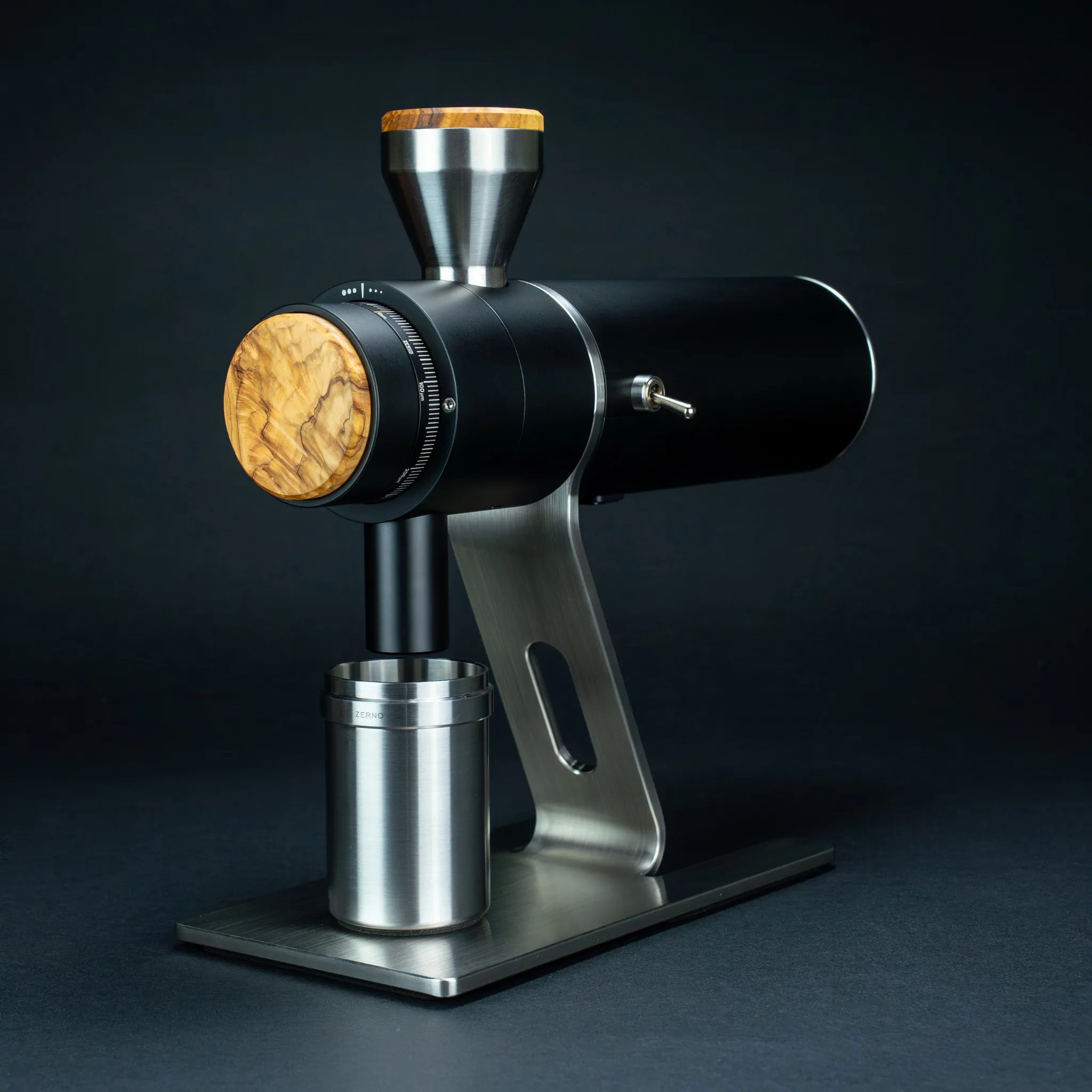
Zerno Z1

  • 64mm Blind Burrs
  • Modular Auger System
  • <25 Micron Alignment
  • SSP Compatible
Approx $1,995

The Zerno Z1 is the surprise of this list. At 64mm, it shouldn't compete with the larger platforms. But it does.

The secret is the interchangeable auger. Users swap between slow and medium feed rates. Starving the burrs reduces particle population in the cutting zone, minimizing regrinding. This mechanical trick mimics what variable RPM does electronically.

With SSP blind burrs installed, the Z1 produces clarity that rivals 80mm grinders at nearly half the price. If $3,500 feels like too much, this is where to look.

Testing the Zerno Z1 grinder against prosumer platforms in our comparison evaluation
The Zerno Z1 held its own against 80mm+ platforms during blind taste testing.

Prosumer conical grinders that still make sense

Flat burrs get all the hype in the prosumer market. But conicals do something flats struggle with: texture. More fines mean thicker body, syrupy mouthfeel, and flavors that blend instead of separating. If you drink cortados or oat milk lattes, this is what you want.

Best Conical

Kafatek Monolith MC6

  • 71mm Dual Conical System
  • Shurikone 2 Geometry
  • Pre-Crusher Burr
  • Balanced Texture/Clarity
Approx $3,650

The Monolith MC6 bridges two worlds. It uses a dual-conical system with a pre-crusher feeding the main Shurikone burrs. This tightens the particle curve compared to traditional conicals.

You still get the gooey texture conical lovers want. But flavor notes stay distinct instead of muddying together. It handles light roasts better than any conical we've tested. If you want body AND clarity, the MC6 is the closest you'll get.

Best Traditional Espresso

Weber Workshops Key mk2

  • 83mm Mazzer Conical
  • 50% More Torque vs mk1
  • Bean Feeder Mechanism
  • Vertical Form Factor
Approx $2,995

The Key mk2 leans into classic espresso character. No compromises toward clarity. Just massive body, rich blended flavors, and the thick texture that cuts through milk.

The 83mm Mazzer burrs are legendary. Notes merge together the way they do in Italian espresso bars. The mk2 update added 50% more torque, finally solving the stalling issues with dense beans. If clarity isn't your priority, this is the conical to get.

Best Hybrid

Versalab M4

  • 68mm Flat + Conical Pre-breaker
  • Belt-Driven Motor
  • Zero WDT Required
  • Donut Distribution Output
Approx $2,650

The Versalab M4 is the weird one. Conical pre-breaker into flat finishing burrs. Belt drive isolating motor heat. It's been around since 2005 and still nothing else works quite like it.

Grounds deposit in a perfect donut shape needing zero distribution work. The cup lands between a pure conical and a pure flat. More clarity than the Key. More body than the EG-1. If you can't decide between approaches, this splits the difference.

Prosumer grinder technology in 2026

Why blind burrs took over

Traditional burrs have screw holes on the cutting face. Manufacturers needed them to mount the burr to the carrier. The problem: those holes create dead zones where beans get crushed unevenly rather than cut cleanly. Fines accumulate in the gaps. The effective cutting surface shrinks.

Blind burrs eliminate the holes entirely. Mounting happens from behind or via magnets. The result is 10-15% more usable cutting surface and measurably tighter particle distribution. A 64mm blind burr now performs closer to a traditional 80mm. This shift explains why smaller grinders like the Zerno Z1 can compete with larger platforms.

Feed rate vs RPM

For years, variable RPM was the headline feature. Slower meant less heat and fewer fines. Faster meant quicker grinding. Simple story.

But grind quality depends on something else: how many beans hit the burrs at once. If you dump 18 grams into a hopper all at once, beans compete for space in the cutting zone. Some get crushed multiple times. Some bounce around and shatter unpredictably. The distribution widens.

Augers and pre-breakers solve this mechanically. They regulate the flow. A slow-feed auger starves the burrs on purpose, feeding beans one at a time. The result mimics low-RPM grinding even at higher speeds. This explains why the Zerno Z1's swappable auger and Kafatek's pre-crusher systems produce such consistent results.

Alignment tolerances matter more than you think

Burr alignment is the gap between marketing and reality. A prosumer grinder can have premium burrs and still underperform if those burrs wobble during rotation. Even 20 microns of runout introduces boulders into the grind that muddy extraction.

The Flat MAX ships with sub-10-micron alignment verified by refractometry. The EG-1's magnetic mounting makes realignment after cleaning unnecessary. The Z1 achieves sub-25-micron tolerances at half the price of the Titans. These aren't premium features. They're the baseline for prosumer grinding.

How to pick the right prosumer grinder

Forget burr size. Start with these questions to find the right prosumer grinder for your setup.

What do you brew?

Filter only: Look at flat burrs for clarity. The Z1 or Lagom 01 depending on budget.
Espresso only: Depends on your taste. Light roasts need the Flat MAX or EG-1. Traditional espresso wants the Key mk2 or MC6.
Both: Variable RPM matters. The Lagom 01 handles both at A-grade.

What's your taste preference?

Clarity/separation: Flat burrs, preferably 80mm or larger. The Flat MAX is the ceiling.
Body/texture: Conical or hybrid. The MC6 balances both.
Traditional espresso: Large conical burrs. Key mk2.

How much workflow friction can you tolerate?

The EG-1 has the best daily experience with tool-free cleaning. The Flat MAX is more demanding but rewards technique. The Z1 offers the best value if you're willing to experiment with auger swaps.

Frequently Asked Questions

Do I need a $3,000 grinder?

add

Depends on your palate. If you're drinking light roast single origins and chasing specific flavor notes, the particle uniformity of a Titan grinder makes a real difference. If you're making milk drinks with medium roasts, a mid-range grinder or quality manual option gets you 80% of the way there.

Flat burrs or conical burrs?

add

Flat burrs produce tighter particle distribution for clarity and high extraction. Conical burrs produce more fines for body and texture. Neither is 'better.' Flat for light roasts and filter. Conical for traditional espresso and milk drinks.

What does 'retention' mean?

add

Retention is coffee trapped inside the grinder between sessions. Old grounds mix with fresh ones. All grinders in this guide achieve sub-0.1g retention, making them true single-dosers. Consumer grinders often retain 2-5g.

Why are 'blind' burrs better?

add

Traditional burrs have screw holes on the cutting face. These create dead zones where beans get crushed unevenly and fines accumulate. Blind burrs have no holes, maximizing cutting surface and producing more uniform particles.

What's the difference between prosumer and commercial grinders?

add

Prosumer grinders are built for home use but with commercial-grade components. They prioritize single-dosing, low retention, and precision alignment. Commercial grinders prioritize speed and hopper capacity for cafe volume. For home espresso, prosumer wins.

verified
The Final Verdict

Our Recommendation

For most prosumer setups, the Lagom 01 is the best grinder you can buy. Variable RPM makes it genuinely versatile across brew methods, and the 102mm Mizen burrs produce clarity that competes with the best. If you want one prosumer grinder that does everything well, this is it.

Option-O Lagom 01

star star star star star (Editor's Choice)
  • 102mm Blind Burrs
  • Variable 200-1700 RPM
  • Auto-Purge
  • <0.1g Retention
Check Best Price