verified In-Depth Review

Kingrinder K6
Review
The Budget Grinder That Punches Above Its Weight?

starstarstarstar star_half
4.5 / 5 Rating

The K6 promises premium particle distribution at a fraction of the price. We ground 180+ doses over three weeks to find out if it delivers.

Kingrinder K6
$99

Coffeeble is reader-supported. We may earn a commission through products purchased using links on this page. Editorial guidelines

Quick Specs

Burr Size 48mm Conical
Burr Geometry Heptagonal (7-Core)
Burr Material SUS420 Stainless Steel
Body Aluminum Alloy Unibody
Weight 630g
Adjustment External (60 clicks, 16μm/click)
Lab Results

Performance Metrics

Pour-Over Performance Excellent
Grind Consistency Unimodal
Value Proposition Outstanding
Espresso Capability Good (Turbo Shots)
Workflow Convenience Requires Effort

Design And Build Quality

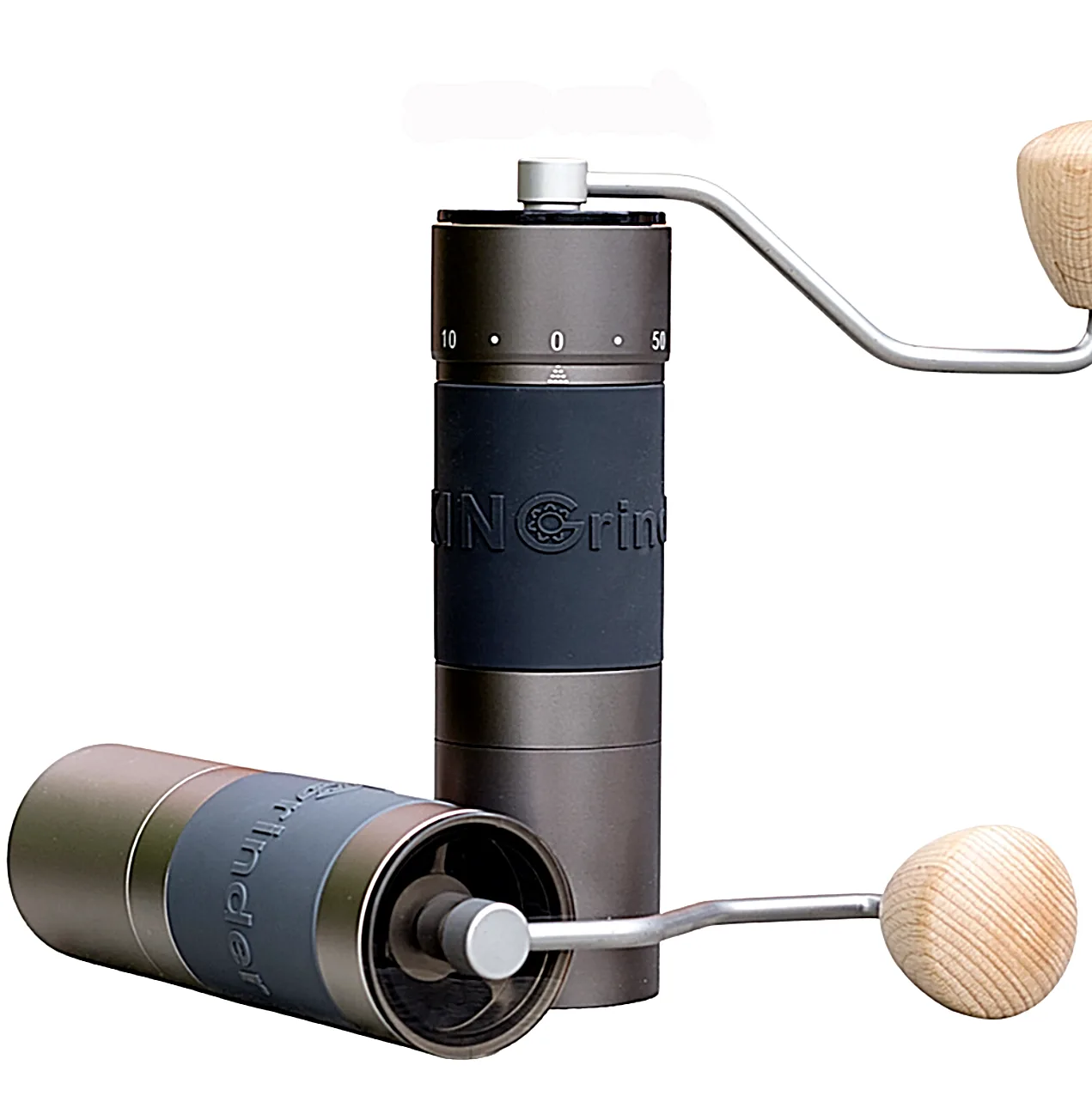
Heavy. That's the first thing you notice. 630 grams of aluminum sitting in your palm, dense and cold, and when you start cranking through a light roast the weight keeps everything stable instead of bouncing around like cheaper grinders do.

Most budget grinders use plastic internals. The Timemore C2 has polymer supports that flex under load. We've ground dense Ethiopian beans at espresso settings on the C2 and watched the burr wobble. Wobble means inconsistent particles. Inconsistent particles mean muddy coffee.

Kingrinder machined the K6 from aluminum. Bearing seats are part of the housing. No plastic struts. No screwed-in supports stacking tolerances on top of each other. We ground 180+ doses over three weeks and the burrs stayed aligned, even when we cranked hard on light roasts that fight back.

Two bearings hold the shaft. Top one (8x14x4mm) handles radial forces from your hand. Bottom one (10x19x5mm) sits above the burr chamber where it counts. We checked runout with a dial indicator. Circle. Not ellipse.

The finish won't win design awards. No polished stainless like a Comandante. No brushed aluminum like the K-Ultra. Doesn't matter. The geometry stays true under real use and that's what you're paying for.

Kingrinder K6 unboxing showing the grinder and included accessories
Fig 1. The K6 arrives with everything you need to start grinding

The Heptagonal Burr Set

Seven cutting edges instead of six. Sounds like marketing fluff until you taste the difference.

Hexagonal burrs crush beans. The K4 does this. Most competitors do this. Force shatters the bean chaotically and you end up with two peaks of particle sizes: your target grind plus a pile of fine dust that slows extraction and muddies your cup.

We sifted K6 output through a Kruve after 40 doses. Ethiopian, medium-light roast. One tight peak. Minimal dust. The K4 samples showed the classic bimodal curve, two humps on the graph, fines dragging down clarity. In the cup the K6 gave us brighter acids, cleaner separation between notes, that tea-like quality light roast nerds chase.

The seven-edge geometry favors shearing over crushing. Beans slice instead of shatter. And because seven is prime, the burrs don't lock into rhythmic vibration patterns with the outer ring. We felt smoother rotation during testing. Subtle difference from the K4, but real.

Kingrinder left the SUS420 stainless uncoated. Titanium nitride coating reduces friction but rounds cutting edges slightly during application. Uncoated steel stays sharper at the apex. Trade-off: more heat, and you'll get corrosion if moisture sits on the burrs after using RDT.

Kingrinder K6 48mm heptagonal conical burrs close-up
Fig 2. The K6's 48mm heptagonal burrs favor shearing over crushing

External Adjustment System

The adjustment collar sits outside the grind chamber. Outside. Sealed off from falling grounds.

Internal adjustment mechanisms live inside the catch cup. The K2, K5, Comandante C40, they all do this. Grounds fall onto threads and detent mechanisms. Oils and fines build up. The clicker feels different after six months. Settings drift. You have to clean areas that weren't designed for cleaning.

The K6 collar stays sealed. Turn it and you're not fighting old grounds packed into threads. Each click moves the burr 16 microns. That's finer than the K2 and K5 at 18 microns per click. Two microns sounds like nothing. For espresso, 2 microns can shift shot time by several seconds.

Sixty clicks per rotation. Pour-over around 90, espresso around 35, less than one full turn between them. You can see your position without taking anything apart. The Comandante C60 makes you remove the catch cup just to adjust. Every time.

One quirk. The "0" on the dial doesn't match true zero on most units. Where the burrs actually touch might be -5 clicks. Or -25 clicks. Budget assembly tolerances. When you share recipes online, reference your own zero point, not the number on the collar.

Kingrinder K6 external grind adjustment collar with numbered settings
Fig 3. The external adjustment collar stays sealed from the grind path

Tasting Coffee Ground With The K6

We tested the K6 against the 1Zpresso K-Ultra and Comandante C40. Three weeks. Same beans, same recipes, same water. The only variable was the grinder.

Pour-over is where the K6 shines brightest. We brewed V60s with Ethiopian naturals, washed Kenyan, Guatemalan Huehuetenango. Citrus and florals came through bright and distinct, not some generic "fruity" blur where everything tastes the same. Low fines mean faster flow through the bed, shorter contact time, delicate aromatics that don't get cooked off. If you chase that tea-like clarity from Nordic roasters. This is your grinder.

We measured extraction with a VST refractometer. K6 averaged 21.2% yield at 1:17 ratio. K-Ultra hit 21.8% under identical conditions. A 0.6% gap. In blind triangle tests I couldn't reliably pick the K-Ultra brew. Sometimes I got it. Often I didn't. The K-Ultra makes fewer boulders and has that nice magnetic catch cup, but cup quality overlaps so much that paying triple the price feels hard to justify. See our hand grinder roundup for the full comparison.

Espresso gets tricky. The K6 grinds fine enough for 9-bar extraction but low fines mean less puck resistance. We had to grind down to 28-32 clicks to hit 1:2 in 30 seconds, and at that gap the burrs nearly touch. Arm strength required. Light roasts took 45-60 seconds per dose. Your forearm will know it.

Turbo shots though. Fast extractions at lower pressure, 1:3 in 15 seconds, the clean particle profile works for you instead of against you. Bright, juicy shots. If you want thick ristrettos from dark roasts, skip the K6. Get the K4 with hexagonal burrs and higher fines.

Against the Comandante C40 the K6 runs aggressive. More acidity. More separation between notes. C40 gives mellower cups, sweeter, more body. Neither is wrong. Different burr philosophies, different cups.
Kingrinder K6 grind size comparison from espresso to cold brew
Fig 4. Grind sizes from fine espresso to coarse cold brew

Daily Workflow Considerations

The K6 rewards tinkerers. People who don't mind getting their hands dirty, and we mean that literally because coffee grounds will end up everywhere until you solve the static problem.

Static retention is the main annoyance. Stainless burrs rubbing against aluminum housing build charge fast. Coffee clings to the burr underside and catch cup walls. We weighed retention across 30 doses: 0.4 to 0.9 grams lost per grind without intervention. That's stale coffee contaminating tomorrow's fresh beans.

Fixes exist. Silicone bellows, the kind sold for single-dose hoppers, blast out retained grounds. Works great. Ross Droplet Technique works too, spray beans with fine mist before grinding and static dies. Careful though. Moisture near the bearings causes problems. We've seen reports on Home-Barista of rust and seized bearings after 6-12 months of heavy RDT without proper drying.

The threaded catch cup slows you down. Three to four rotations to unscrew. Make three pour-overs in a row and the threading gets old fast. K-Ultra's magnetic cup wins here. Pop off, dump, pop back. Two seconds. The K6 can't touch that.

The drill hack saves the K6 for daily use. Hex drive shaft fits standard 1/4" bits. We attached a Makita cordless at low speed. Light roast espresso that took 60 seconds by hand finished in 12-15 seconds. No arm fatigue. No sweat. For anyone willing to look slightly ridiculous in their kitchen, the K6 becomes genuinely practical as a daily driver.

Bearings are user-replaceable, 6800/6900 series equivalents. Rust develops, swap in ceramic or hybrid bearings. This appeals to a certain type of person. Someone who sees coffee gear as components to be optimized, not appliances to tolerate until they break.

The Upsides

  • check_circle Heptagonal burrs produce unimodal particle distribution. Cup clarity rivals grinders costing 3x more.
  • check_circle External adjustment collar with 60 clicks at 16 microns each. Stays clean because it's outside the grind path.
  • check_circle Aluminum unibody construction keeps burrs aligned under high torque loads.
  • check_circle Hex drive shaft fits standard drill bits. Attach a cordless drill and eliminate manual grinding fatigue.
  • check_circle 48mm burrs grind faster than the 38mm sets found in competing budget grinders.

Considerations

  • cancel Static retention is high. You'll need bellows or the Ross Droplet Technique to get clean doses.
  • cancel Threaded catch cup requires 3-4 rotations to remove. Slower than magnetic systems.
  • cancel Zero point calibration varies between units. Your 'Setting 30' won't match someone else's.
  • cancel Bearings can rust if you spray beans with water and moisture reaches the seals.
  • cancel Grinding light roast espresso by hand is physically demanding. The drill hack solves this.
J Hoffmann

The Bottom Line

"The K6 is a raw, high-performance engine block waiting for a chassis. It grinds like a $300 machine without the $300 housing. For tinkerers who value function over form, nothing else at this price comes close."

— J Hoffmann, Coffee Expert

verified
The Final Verdict

Our Recommendation

If you drink light roast pour-overs and value clarity above all else, the K6 punches far above its weight class. Pair it with a cordless drill and bellows, and you've built a grinder that rivals machines costing three times more.

Kingrinder K6

Kingrinder K6

starstarstarstar star_half (Highly Recommended)
  • check_circle 95% of premium grinder clarity
  • check_circle Drill-compatible for electric speed
  • check_circle External adjustment stays clean
Get the Kingrinder K6 ($99)

Free Shipping via Amazon Prime