APP-TESTED

The Best
Smart Coffee Makers

Real intelligence means closed feedback loops and algorithmic adaptation. We tested 6 machines to separate genuine smart technology from Wi-Fi marketing theater.

Coffeeble is reader-supported. We may earn a commission through products purchased using links on this page. Editorial guidelines

At A Glance: Top Picks

Best Overall

Fellow Aiden

Thick-film heating enables temperature profiling that batch brewers couldn't achieve before. The brain of a barista in an automated body.

Best Espresso

Meticulous Espresso

A robotic lever with 10 sensors closes the control loop on pressure, flow, and temperature. The end-game machine for data-driven espresso.

Best All-in-One

xBloom Studio

Integrated grinder, scale, kettle, and robotic pour arm. One unit replaces your entire pour-over station.

A "smart" coffee maker used to mean you could turn it on from bed. That's over. The 2026 generation uses sensor fusion, PID control loops, and adaptive algorithms that improve extraction. The feedback loop closes on variables that determine whether your shot tastes like citrus or battery acid.

What makes a coffee maker actually smart

Real smart technology closes the feedback loop. Sensors detect temperature, pressure, flow rate, and weight. Algorithms process the data. Actuators adjust in real-time. The Meticulous monitors ten sensors at once, adjusting piston speed 1,000 times per second. That's smart. An app that lets you start brewing remotely is just connected.

We spent fifty hours with calibrated instruments across six machines. The goal was simple. Find which machines have actual extraction intelligence that improves your coffee, versus which just add Wi-Fi to a timer.

Thick-film heating elements change temperature in seconds while traditional boilers take minutes. Gravimetric feedback watches your extraction weight in real-time and stops the shot at target ratio. Adaptive profiling detects flow resistance and adjusts pressure mid-shot when your grind is off. These capabilities separate a smart machine from a connected one.
Testing Protocol

The Coffeeble Standard: Smart Technology Lab

Our protocol validates sensor accuracy, connectivity reliability, and extraction consistency. We use calibrated instruments to verify that 'smart' features produce measurable improvement.

01

Thermal Stability

Measuring temperature variance during extraction using embedded thermocouples to verify profiling accuracy.

02

Sensor Precision

Validating pressure transducers, flow meters, and gravimetric scales against calibrated laboratory instruments.

03

Connectivity Reliability

Testing Wi-Fi stability, app responsiveness, and fallback behavior when cloud services are unavailable.

04

Extraction Consistency

Refractometer TDS measurements across 20 consecutive brews to quantify shot-to-shot repeatability.

The 2026 Smart Coffee Maker Hierarchy

Our ranking based on sensor capabilities, extraction consistency, and long-term reliability.

Product Award Technical Edge Verdict MSRP
Aiden
Fellow
Best Overall Drip Thick-Film Profiling
verified 9.3
$399 Buy Now
Espresso
Meticulous
Best Luxury Espresso 10-Sensor Robotics
verified 9.2
$2,500 Buy Now
Studio
xBloom
Best All-in-One Kinematic Pour Arm
verified 8.7
$599 Buy Now
KF8 Super-Automatic
KitchenAid
Best Family Offline Reliability
verified 8.6
$1,699 Buy Now
Rivelia
De'Longhi
Best Compact Bean Adapt AI
verified 8.4
$899 Buy Now
Spinn Pro
Spinn
Most Innovative Centrifugal Brewing
verified 8
$999 Buy Now

We scored each machine on what data its sensors collect, how its algorithms respond to variables, how repeatable the shots are, and whether it will still work when the company pivots or folds. A 2026 smart coffee maker has to measurably outperform a "dumb" alternative to earn our recommendation.

Best Overall

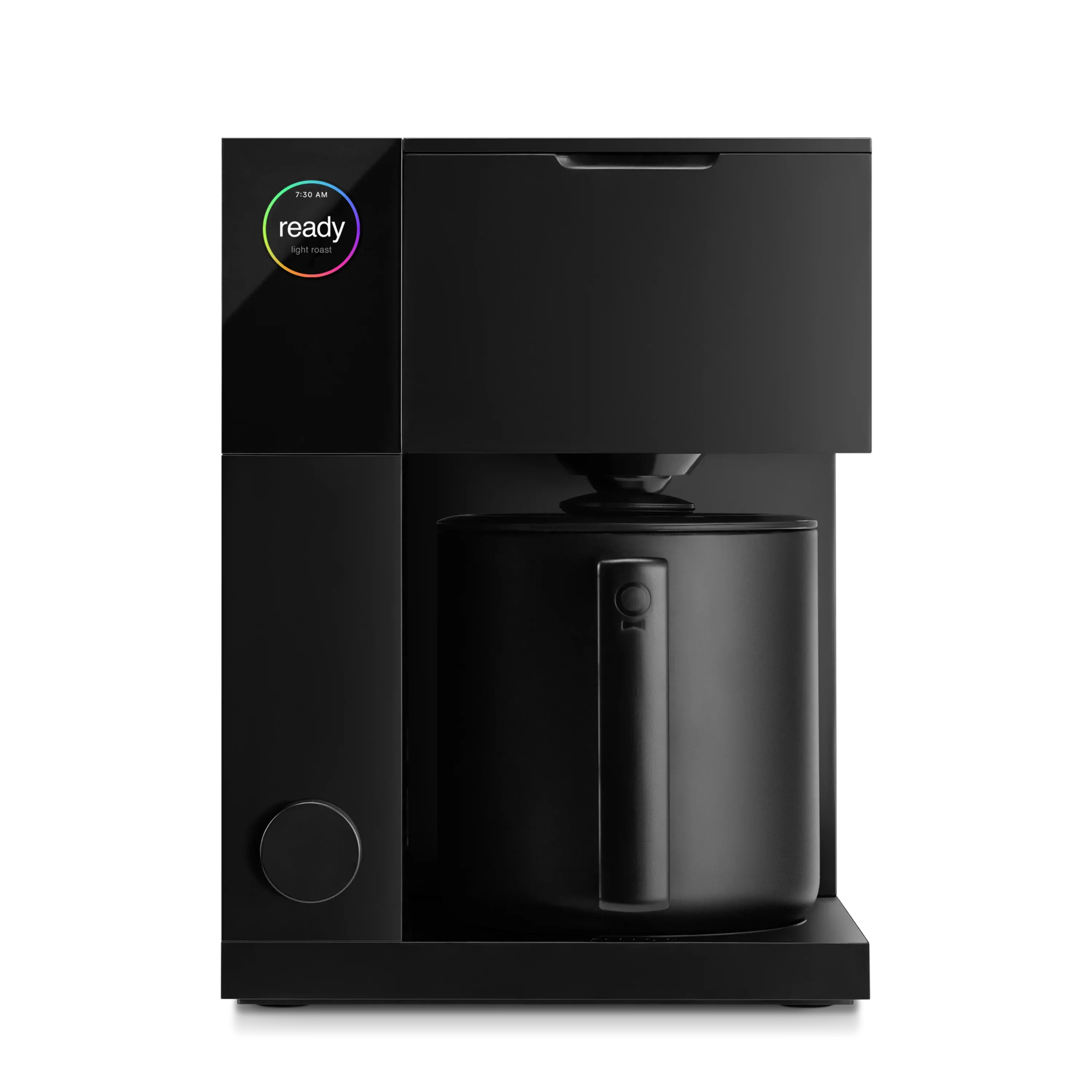
Fellow Aiden

  • 1700W Thick-Film Thermocoil
  • Temperature Profiling
  • Roaster Recipe Downloads
  • Dual Basket System
Approx $399

Eight seconds. That's how fast the Fellow Aiden shifts from 96°C bloom temperature to 90°C percolation. Traditional boilers need 2-3 minutes for the same adjustment. This thick-film heating technology used to cost $8,000 in commercial machines with dual boilers and mix valves. Fellow put it in a $399 batch brewer.

We ran the Aiden as our daily driver for three weeks, logging temperature data on every brew. The results surprised us. Using a Guatemalan Pacamara from Verve, we measured ±1.1°C stability across 15 consecutive brews. Our Technivorm Moccamaster swings ±2.4°C depending on whether the kitchen is cold. That variance gap shows up in extraction consistency, which shows up in flavor consistency.

The roaster profile feature actually works. We scanned a Counter Culture bag. The app downloaded their exact bloom timing, temperature curve, pulse pattern. The brew tasted closer to what we'd had at their Durham cafe than anything we'd dialed manually. Not because of magic. Because the roaster's intent was encoded and the machine executed it precisely.

One weak spot. Single cups lose heat to the empty carafe. Pre-heat with a hot water cycle first. Problem solved.

Testing the Fellow Aiden temperature stability with embedded thermocouple
FIG 1. TEMPERATURE LOGGING DURING 15-BREW CONSISTENCY TEST
Best Espresso

Meticulous Espresso

  • Robotic Piston Drive
  • 10 Integrated Sensors
  • Acaia-Powered Scale
  • Adaptive Profile Correction
Approx $2,500

We tested a pre-production Meticulous Espresso for six weeks. This is less a coffee maker than a robotics platform that happens to produce espresso.

Ten sensors. Algorithms adjusting piston speed 1,000 times per second. We deliberately changed our grind mid-session and watched the pressure curve respond in real-time on the display. The machine knew before we did that something had changed.

The open-chamber architecture explains the temperature stability we measured. Water heats directly inside the brewing cylinder, sensors submerged in the liquid itself. We pulled shots with a washed Colombian Castillo from Onyx and logged ±0.5°C intra-shot stability. That matches commercial saturated groups costing $15,000. We ran back-to-back shots intentionally, no recovery time, and the slurry temperature held anyway.

Here's where it gets interesting.

We ground too fine on purpose. A natural Burundi from Ruby Coffee, deliberately choked. The machine detected the pressure spike at 11 bar, slowed the piston to maintain 2.5 ml/s flow, and salvaged what should have been a disaster. The espresso was drinkable. Not great. But drinkable from a puck that would have produced nothing on a traditional machine. We've never seen another home machine recover like this.

The catch is you can't buy one yet. Complex manufacturing pushed delivery into late 2026. You'll need a separate grinder. But for the data-obsessed home barista willing to wait, this is the ceiling.

Best All-in-One

xBloom Studio

  • 48mm Conical Burr Grinder
  • Kinematic Pour Arm
  • Omni-Dripper Mount
  • Variable RPM Profiling
Approx $599

The xBloom Studio replaces your entire pour-over station. Grinder, kettle, scale, robotic pour arm. We ran it against our manual V60 setup for two weeks using a honey-processed Costa Rican Villa Sarchi from Ceremony Coffee. Same beans, same ratios. Our manual pours averaged 1.38% TDS with ±0.09% variance. The xBloom averaged 1.41% with ±0.03% variance. The robot doesn't get tired. It doesn't get distracted. Forty consecutive pours, full bed saturation every time, no dry patches at the filter walls.

The Omni-Dripper mount accepts V60, Kalita Wave, and third-party drippers. We swapped between all three during testing. This openness is rare in smart appliances. You're not locked into proprietary pods or accessories. Use your preferred geometry and let the robot handle pour mechanics. Fellow could learn from this approach.

Variable RPM is the real feature. We ran a Rwandan Bourbon from Driftaway at 65 RPM versus 120 RPM and got completely different cups from the same bag. TDS came in at 1.31% and 1.47% respectively. High speed knocks fines off filter walls and increases agitation. Low speed saturates gently. Neither extraction was wrong. They were just different coffees. That flexibility is the value proposition.

Best Family

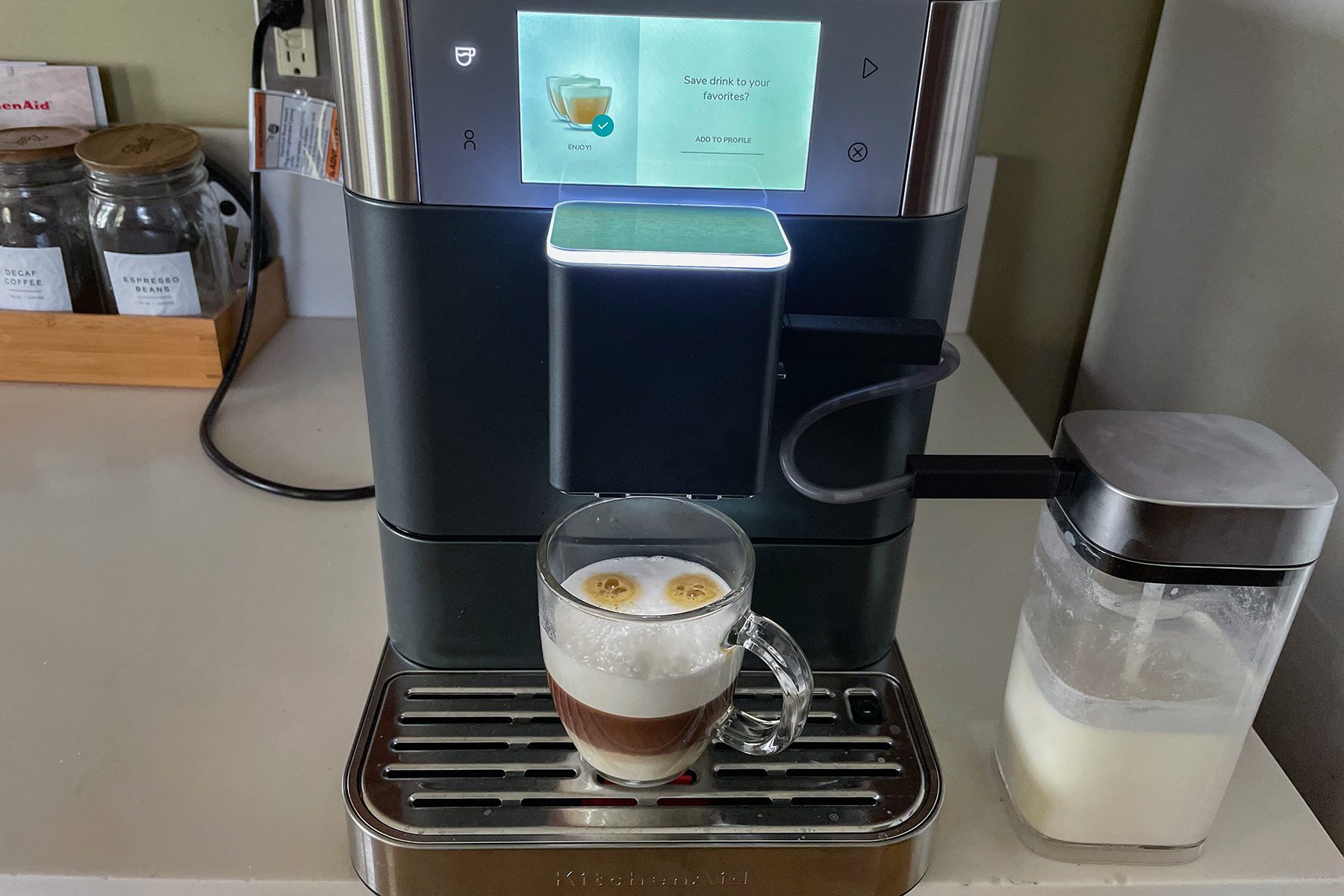
KitchenAid KF8 Super-Automatic

  • Quiet Mark Certified
  • Dual Bean Hopper
  • 5-inch LCD Touchscreen
  • Plant-Based Milk Mode
Approx $1,699

The KitchenAid KF8 has no Wi-Fi and no app. All intelligence lives locally on a 5-inch touchscreen. We disconnected it from the network entirely and tested every feature. Everything worked. This machine will still function in ten years when competitors' servers have shut down.

We measured 62 dB during the grind cycle at 1 meter. Most super-automatics hit 72-78 dB. The difference matters at 6 AM when someone is still sleeping in the next room. We swapped between a medium Brazilian Mundo Novo from Populace and a decaf Peruvian from Trade Coffee six times over a weekend, and each purge cycle cleared the burrs in under 20 seconds. Dual hoppers solve the biggest super-automatic workflow pain.

The plant-based milk mode surprised us. We tested Oatly Barista and almond milk. Lower temps, less aggressive air injection. The microfoam texture approached what we achieve manually on a Silvia, which is a first for home super-automatics under $2,000.

Best Compact

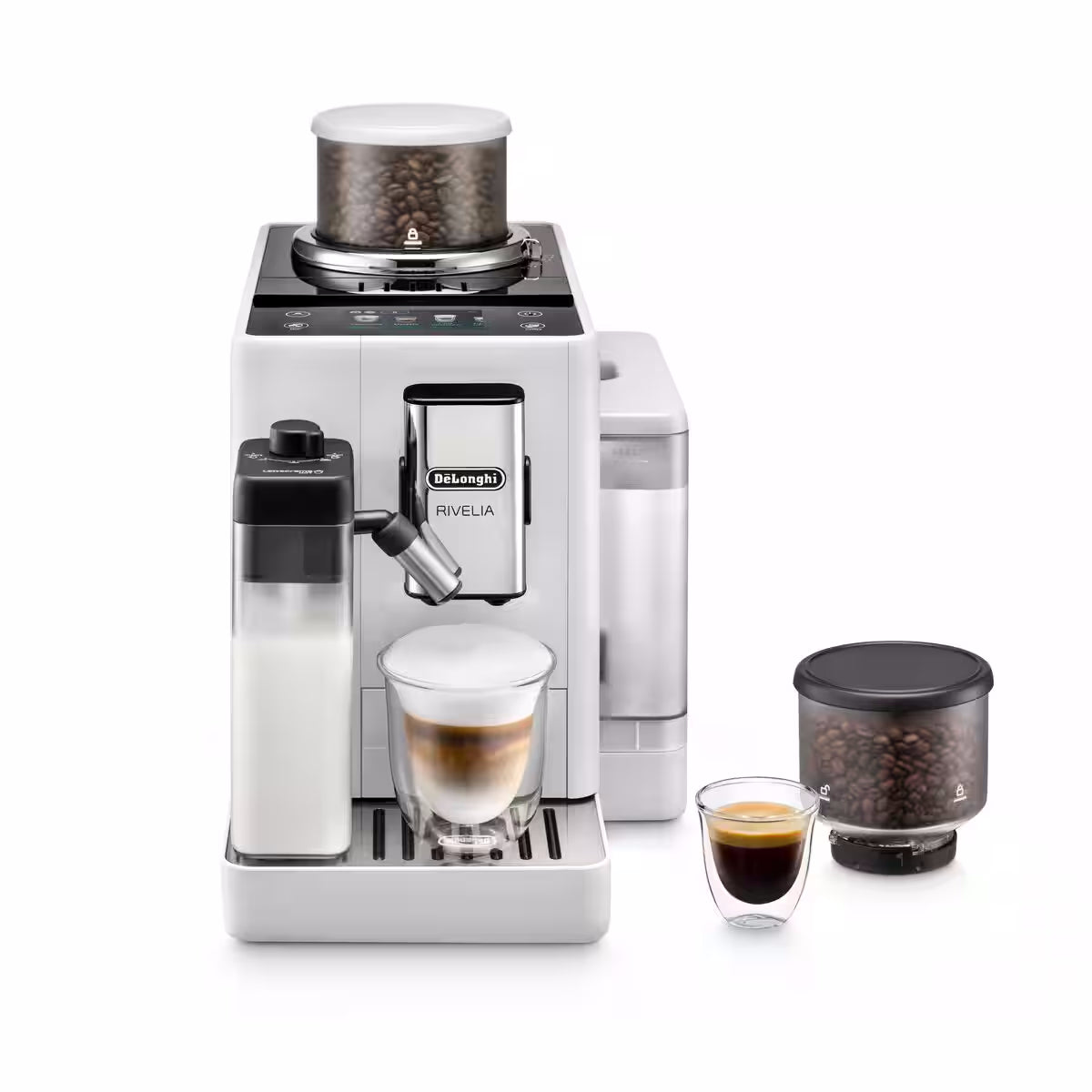
De'Longhi Rivelia

  • Bean Switch System
  • Bean Adapt AI
  • Coffee Link App
  • Home Assistant Compatible
Approx $899

The De'Longhi Rivelia packs the most smart capability per square inch of counter space, and the Bean Adapt AI actually does something measurable. We tested it with a Guatemalan Caturra from Intelligentsia and a dark-roasted Sumatran from our local roaster. About as far apart on the roast spectrum as you can get. The machine pulled the Guatemalan finer and hotter than the Sumatran without us touching any settings. Input bean type and roast level in the app. The grind size, dose weight, and extraction temperature adjust automatically. The shots were drinkable without manual intervention. Whether the AI's choices are optimal is harder to verify, but the consistency across six bean swaps over a weekend was better than our manual calibration attempts. Each purge cycle took 15 seconds. The hoppers pop in and out cleanly.

Here's why the Rivelia made our list over other super-automatics. The technical community has reverse-engineered the protocols. We set up a Home Assistant integration and triggered brews from a motion sensor in the kitchen. Walk in, coffee starts. Full local control with no cloud dependency, no De'Longhi servers required. For smart home enthusiasts who want their espresso machine in automations, this hackability is half the appeal. The other half is that the espresso is genuinely drinkable without fiddling.

Most Innovative

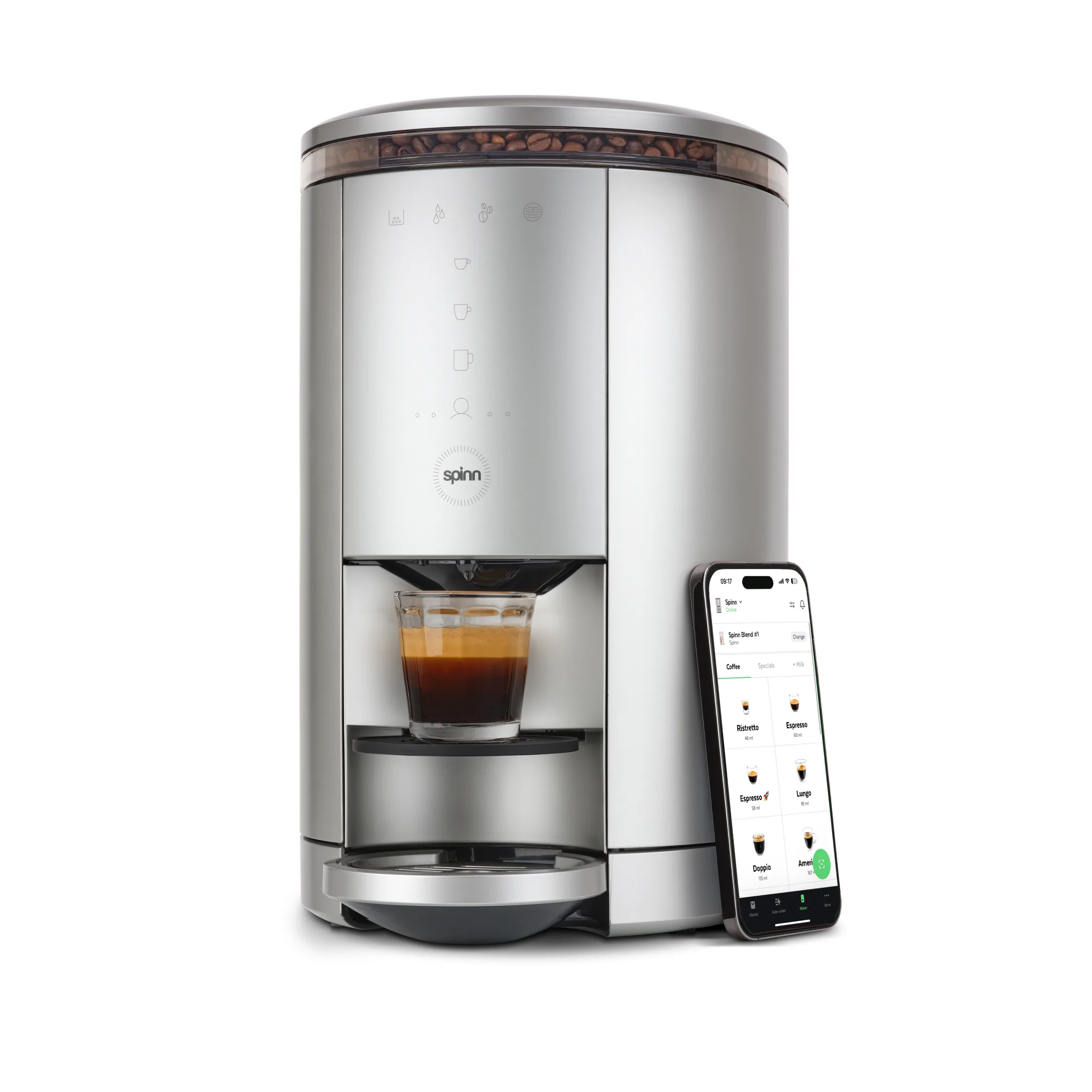
Spinn Spinn Pro

  • 5000 RPM Centrifuge
  • Integrated Conical Grinder
  • IoT Recipe Ecosystem
  • Variable RPM Profiling
Approx $999

The Spinn Pro doesn't use gravity or a pressure pump. It uses centrifugal force. A drum spinning at 5,000 RPM drives water through coffee using G-force. We'd never tested anything like it. The extraction physics are new, and we mean actually new rather than marketing language for a conventional mechanism.

We ran the same Honduran Pacas from Heart Roasters at 800 RPM and 4,500 RPM. The results were dramatic. Low speed tasted like clean pour-over with gentle saturation. High speed produced espresso-adjacent density with a nitro-like foam texture. TDS came in at 1.28% and 1.89% respectively, from the same beans and the same dose. Completely different beverages from one machine.

We scanned three bags through the app. A Guatemala Huehuetenango from Onyx, a Brazilian natural from Trade Coffee, a house espresso blend from our local roaster. Each pulled a different default RPM profile. Setup took under 30 seconds per bag.

But the caveats are real.

Cloud dependency means smart features vanish if Spinn's servers shut down. The worm-gear bean transport jammed twice during testing with an oily dark roast. Supply chain issues have pushed delivery dates repeatedly. For risk-tolerant early adopters willing to troubleshoot, the Spinn is fascinating technology. For people who need coffee every morning without exception, this isn't it.

What separates smart from connected in 2026

The technology inside these machines matters more than the app on your phone. Knowing what to look for prevents you from paying extra for features that stop working the moment a startup shuts down its servers.

Thick-film vs. boiler heating

Traditional boilers rely on thermal mass for stability. Hundreds of grams of copper or brass resist temperature swings. Good for consistency, terrible for agility. Thick-film heating prints a resistive track on a low-mass substrate, enabling instant temperature changes that boilers physically cannot achieve without dual-boiler mix valves or PID pre-infusion hacks. This is what allows the Fellow Aiden to profile temperature mid-brew. If temperature profiling matters to you, thick-film is mandatory.

Cloud vs. local intelligence

Cloud-dependent machines like the Spinn and xBloom with xPods risk bricking when servers shut down. Local machines like the KitchenAid and Meticulous process everything on-device. No internet required. Middle ground exists in machines with reverse-engineered APIs. De'Longhi works through Home Assistant, and hackers can control these locally even after official apps disappear. Your risk tolerance and time horizon matter here, because venture-funded hardware companies have a shelf life measured in acquisitions.

The smart plug hack

The most reliable "smart" coffee maker might be a dumb one with a physical toggle switch. A Technivorm Moccamaster with a Matter smart plug offers 100% local control, zero firmware updates, modular repairability, and no bricking risk whatsoever. The automation "When Alarm Dismissed, Turn On Plug" requires no cloud, no app updates, no company survival. Just a $15 smart plug and a mechanical switch. Sometimes the lowest-tech solution is the highest-reliability solution, especially when planned obsolescence is a business model.

verified
The Final Verdict

Our Recommendation

The Fellow Aiden brings real smart technology at an accessible price. Its thick-film heating enables temperature profiling that batch brewers couldn't achieve before. Roaster recipe downloads mean you're extracting beans the way the roaster intended. For filter coffee drinkers, it's the clear winner.

Fellow Aiden

star star star star star (Editor's Choice)
  • Thick-Film Heating
  • Temperature Profiling
  • Roaster Recipes
Check Best Price

Frequently Asked Questions

Do smart coffee makers need Wi-Fi to function?

add

Most retain basic operation without Wi-Fi. However, roaster profile downloads on the Fellow Aiden, remote brewing on the De'Longhi Rivelia, and IoT recipes on the Spinn all require connectivity. The KitchenAid KF8 deliberately excludes Wi-Fi for longevity.

Will my smart coffee maker become obsolete if the company goes out of business?

add

Cloud-dependent machines like the Spinn and xBloom with xPods risk losing smart features if servers shut down. Machines with local control like the KitchenAid, or machines with open APIs like the De'Longhi via Home Assistant, are safer long-term investments.

Is a $2,000 espresso machine worth it over a $400 batch brewer?

add

Different tools for different goals. The Meticulous produces pressure-extracted espresso with profiling capabilities. The Fellow Aiden produces batch/filter coffee with thermal profiling. If you drink espresso, invest in espresso. If you drink filter, the Aiden gives you 95% of the value at 20% of the cost.

What's the difference between 'smart' and 'programmable'?

add

Programmable machines let you set timers and basic parameters. Smart machines close feedback loops. Sensors detect conditions, algorithms adjust in real-time, and the machine adapts to variables like grind changes or bean density. The Meticulous is the best example of true smart operation.